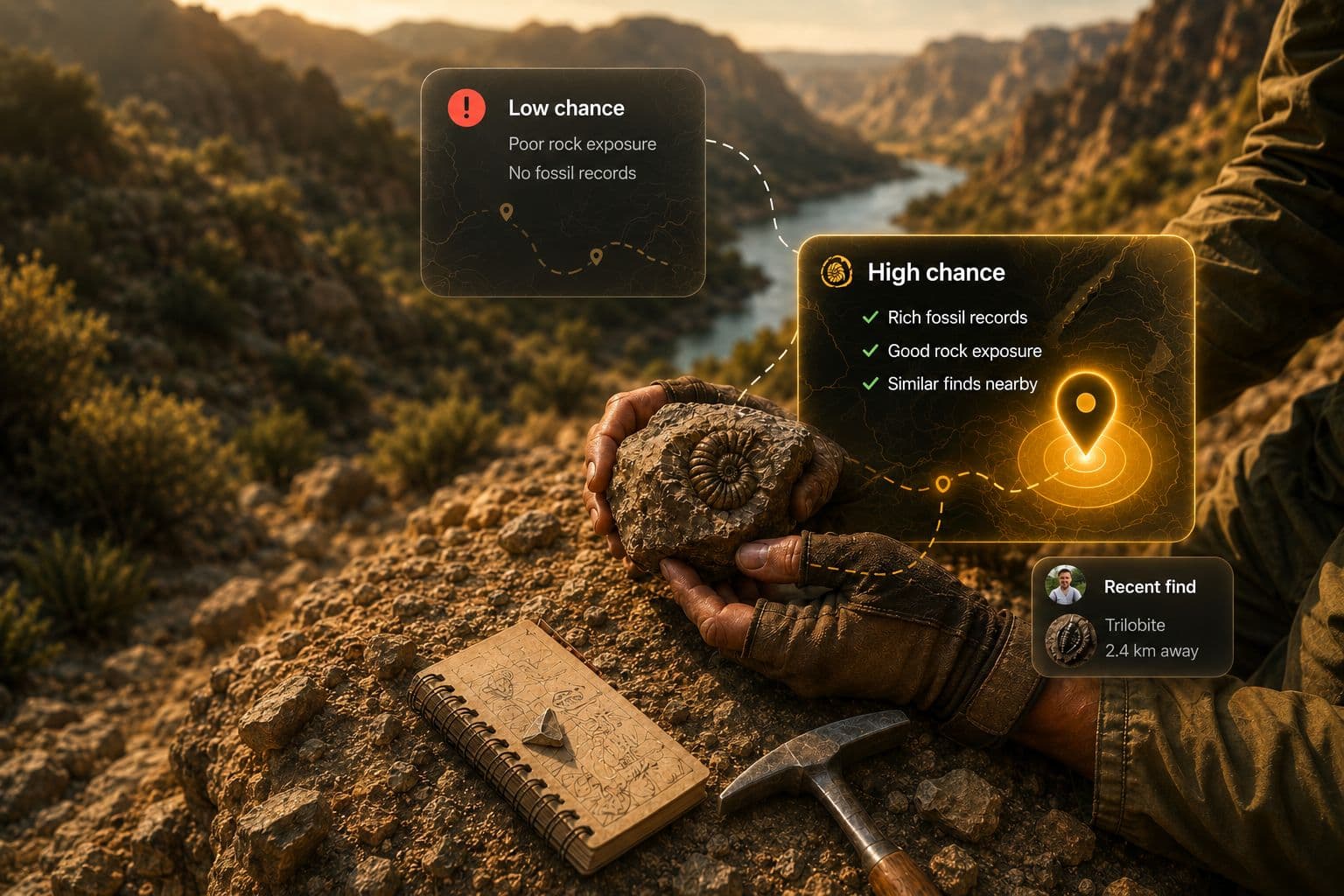

Most people picture fossil hunting as a trip to a famous formation in a remote state. In practice, the productive sites are far more ordinary than that. What matters is not fame — it is fresh exposure of the right kind of rock.
Two conditions have to be met. The rock has to be sedimentary, because that is essentially the only kind that preserves fossils. And it has to be exposed, because you cannot search what soil and vegetation are covering. Anywhere those two overlap is worth a look.
Here are ten kinds of place that reliably deliver, roughly in order of how accessible they are.
1. Stream and river gravel bars
Running water cuts down through layers and concentrates dense material on the inside of bends. It does the excavation and the sorting for you, and it refreshes itself after every flood. For most people this is the single best starting point.
2. Road cuts
When a highway is blasted through a hillside, the result is a clean vertical face through undisturbed layers — the kind of exposure that would take years to dig by hand.
Two warnings. Never park on the shoulder of a fast road or work a face with traffic behind you; the risk is real and it is not worth it. And road cuts are frequently on state right-of-way where collecting is prohibited. Check before you swing anything.
3. Coastal cliffs and beaches
Sea cliffs erode continuously, and every storm delivers a fresh supply of material to the beach below. Search the strandline and the base of the cliff rather than the cliff itself — the exposed face is where rockfall comes from, and standing under an actively eroding cliff is the most common way fossil hunters get hurt.
Work the falling tide, and know when it turns.
4. Quarries and gravel pits
Working quarries offer enormous fresh exposure and are the source of a large share of significant finds. They are also active industrial sites: you need explicit permission, and many operators will grant it for organised group visits when they will refuse an individual at the gate. Join a local society and go with them.
5. Construction sites and new developments
A foundation excavation is a temporary window into rock that will be sealed under concrete within weeks. Ask the site manager. The answer is often no, but it costs nothing to ask, and the material is otherwise simply destroyed.
6. Eroding hillsides and badlands
Where slope and climate keep vegetation from taking hold, weathering exposes new material continuously. Badlands terrain in particular is close to ideal: soft sedimentary rock, minimal cover, constant erosion.
7. Ploughed fields
In glaciated regions, fields turn up erratics — rocks carried and dropped by ice — many of them fossiliferous. The plough refreshes the surface every season. This is private land in almost every case, so ask the farmer, and go after rain when the surface is washed clean.
8. Spoil heaps and mine tailings
Old workings leave piles of discarded rock that was broken up but never examined. Coal spoil in particular is a classic source of plant fossils. Old workings can also be genuinely dangerous — unstable ground, hidden shafts, poor air in any opening. Stay on the heaps and out of the holes.
9. Lake and reservoir shorelines
Drawdown exposes bed material that is normally underwater, and wave action does the same sorting job a river does. Late-season low water is the window.
10. Your own local geology map
This is the one that makes the other nine work. A geological survey map tells you which formations outcrop where, and what age they are. Fifteen minutes with one will save you a dozen wasted trips, because it turns "somewhere around here" into "this specific band of limestone runs along that ridge."
Most national geological surveys publish these free online.
How to choose between them
Rank candidate sites on three things:
- Rock type. Limestone, shale, and sandstone are worth your time. Granite and basalt are not.
- Freshness of exposure. A face that eroded last winter beats a face that has sat weathering since 1990.
- Access. A mediocre site you can legally visit repeatedly beats a superb one you cannot get into.
That third point does most of the work. Familiarity compounds — you learn which bed produces, which corner collects material, what the site looks like after rain. A site you visit twelve times will out-produce twelve sites you visit once.
Before you go
Confirm land ownership and get permission where it is private. Check the collecting rules for the jurisdiction, which frequently distinguish between common invertebrate fossils and vertebrate material — the latter is protected in many places regardless of who owns the land.
Tell someone where you are going. Take more water than you think you need. Leave the site as you found it.
And record what you find, where you found it, and which layer it came from. A box of unlabelled fossils is worth very little, to you or anyone else. A dozen well-documented specimens from a bed you can find again is the beginning of an actual collection.